The telehealth regulatory landscape is a patchwork that no provider can track manually. TeleVerify monitors every change and maps it to your specific credentials — so you always know exactly where you stand.
See Your Coverage MapNot every compact applies to every provider. A psychologist sees PSYPACT states. A social worker sees Social Work Compact states. A physician sees IMLC states. TeleVerify filters everything to your credential type — no noise, no confusion.
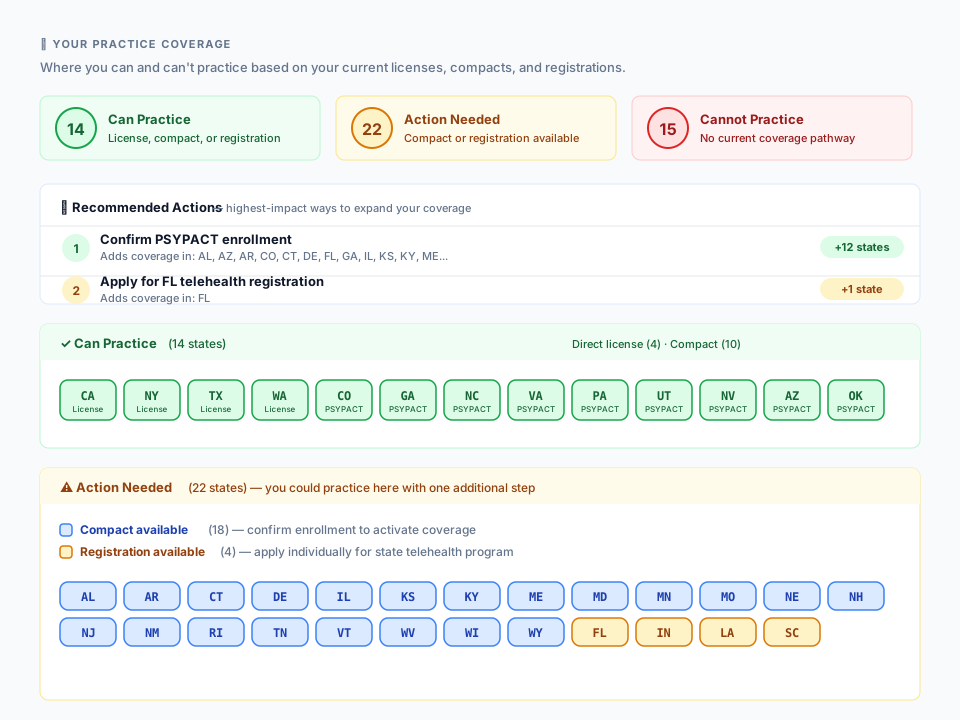
See where you can practice today, which states have available pathways, and ranked actions to expand your coverage — sorted by impact (e.g., "confirm PSYPACT enrollment → +12 states").
Organization-wide coverage table showing every provider's status across all states. Drill into any provider. See coverage gaps where patients exist but no provider is authorized.
Interstate compacts let providers treat patients across state lines without a separate license in every state — but enrollment isn't automatic. Each compact requires individual application, fees, and ongoing renewal.
Beyond interstate compacts, 14 states operate their own telehealth registration or authorization programs. These programs have separate enrollment requirements, fees, and renewal timelines that exist independently of compact membership.
TeleVerify tracks registration requirements and renewal timelines for all 14 programs.
Many providers believe that an existing relationship with a patient, or an urgent clinical situation, exempts them from cross-state licensure requirements. The reality is more complicated.
In 39 states, an existing provider-patient relationship does not exempt you from licensure requirements. If your patient moves to one of these states, you cannot continue treating them via telehealth without obtaining a license, enrolling in a compact, or registering in that state — regardless of how long you’ve been their provider.
Only 12 states currently recognize established-patient exceptions: AL, AK, AR, IN, MN, MO, MT, NC, NE, NY, OR, and TN. Requirements vary — some require a prior in-person visit, others allow any documented treatment history.
Every state recognizes some form of emergency exception allowing an out-of-state provider to treat a patient without local licensure. But the scope varies dramatically — some states limit it to imminent danger to life, while others define emergencies more broadly.
Emergency exceptions are not a compliance strategy. They apply to genuine emergencies only, and relying on them for routine care is a fast path to a board complaint. TeleVerify flags when a session falls outside your authorized coverage so you can make informed decisions.
Many providers assume that because their state participates in a compact, they're automatically covered. They're not. Compact membership means the state has joined — but the individual provider must still apply, pay fees, and be approved before they can practice under the compact's authority. Treating a patient in a compact state without completing enrollment is the same as practicing without a license.
A psychologist in Ohio treats a patient in Florida. Both states are PSYPACT members — but the provider never completed the PSYPACT enrollment process. This session is non-compliant, and the provider is practicing without authorization.
TeleVerify flags this as REVIEW NEEDED
The same psychologist completes PSYPACT enrollment, receives their E.Passport, and is authorized to practice in all 43 member states. The same Ohio-to-Florida session is now fully compliant via compact.
TeleVerify marks this as COMPLIANT VIA COMPACT
New states join compacts. Fee structures change. State programs update their registration requirements. Telehealth flexibilities get extended or expire. Keeping track of all of this manually is a full-time job — and getting it wrong carries real consequences.
PSYPACT enrollment fees increasing in 2026
New Hampshire joins OT Compact — expands coverage to 38 states
Illinois updates telehealth registration requirements — renewal deadline June 2026
CMS extends Medicare telehealth flexibilities through December 2027
Sample alerts — TeleVerify monitors regulatory changes and notifies your team automatically.
Every session is checked against the latest compact enrollment data, state licensing records, and program requirements — in real time.
We don't just check if a compact exists — we verify that the provider has actually enrolled. Compact membership without enrollment is flagged immediately.
When states join or leave compacts, when fees change, when registration deadlines approach — your team gets notified before it becomes a compliance gap.
TeleVerify identifies states where your providers see patients but lack licensing or compact coverage, and recommends the most cost-effective path to compliance.
Every compliance check is logged with timestamps, license details, and compact status. Export audit-ready reports for any time period with one click.
“We were tracking compact membership in a spreadsheet and checking state rules manually before every new patient. It was taking our compliance team 10+ hours a week. TeleVerify replaced all of that — and it catches things we would have missed.”
Let TeleVerify track the compacts, the state programs, and the constant regulatory changes — so you can focus on patient care.